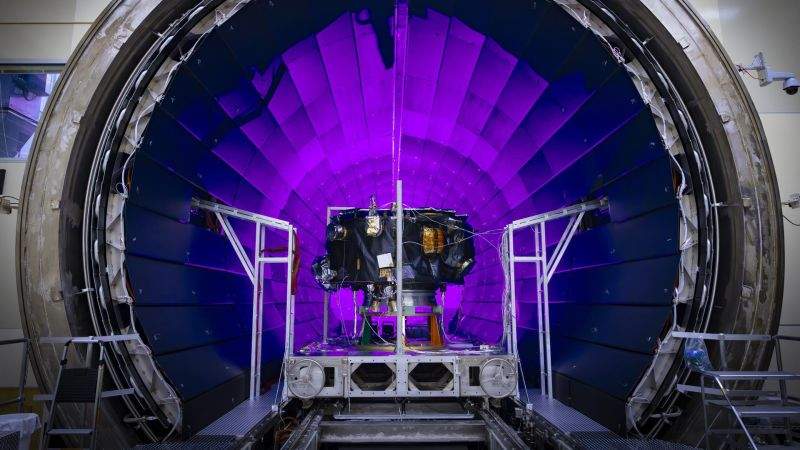
NASA launches ambitious IMAP mission to study cosmic shield
NASA successfully launched the Interstellar Mapping and Acceleration Probe, known as IMAP, aboard a SpaceX Falcon 9 rocket from the Kennedy Space Center in Florida on Wednesday at 7:30 a.m. ET. Citing reports from space officials, the mission aims to unravel the mysteries of the heliosphere, a massive cosmic bubble created by the solar wind that shields planets in our solar system from harmful galactic radiation.
Based on reports from the space agency, the heliosphere stretches far beyond Pluto and plays a vital role in making life possible on Earth by blocking high-energy cosmic rays. Over half a dozen past missions have contributed to our current understanding of this boundary, while the Voyager probes have previously collected critical data after exiting the heliosphere entirely.
The newly launched spacecraft features 10 advanced instruments designed to investigate how the sun forms its continuous stream of solar wind. According to NASA, these instruments will fill major gaps in existing maps and provide high-resolution observations of the dynamic interactions taking place at the outermost edges of our solar system.
"IMAP is going to make incredibly detailed pictures that will evolve over time of that interaction region," said Dr. David McComas, IMAP"s principal investigator and an astrophysicist at Princeton University. "It will be able to understand what the shielding is, how the shielding works and what it looks like.'
Mapping the boundaries of our solar system
Scientists have long sought to understand the exact shape and behavior of the heliosphere boundary, which the Voyager 1 and Voyager 2 spacecraft previously crossed in 2012 and 2018 respectively. While those enduring probes offered rare snapshots in just two locations, IMAP will utilize much faster imaging capabilities to map the region with 30 times higher resolution.
According to mission parameters, IMAP will travel to an orbit roughly one million miles away from Earth over the course of three months. From that vantage point, the spacecraft will capture real-time observations of the solar wind and study boundaries located between six billion and nine billion miles away from our planet.
The spacecraft will primarily measure energetic neutral atoms, or ENAs, which are uncharged particles formed when charged ions collide with slow-moving neutral atoms. Because these particles travel in straight lines unaffected by magnetic fields, IMAP can easily trace them back to their invisible origins along the edge of the heliosphere.
"Every human on Earth, as well as nearly every system involved in space exploration and human needs, is affected by space weather," said Dr. Joe Westlake, director of NASA's Heliophysics Division, emphasizing the broad significance of these upcoming observations for modern infrastructure.
Monitoring space weather and protecting Earth
IMAP lifted off alongside two additional spacecraft on the same SpaceX rocket, forming what officials described as the ultimate cosmic carpool for space weather observation. These accompanying satellites include NASA"s Carruthers Geocorona Observatory and the National Oceanic and Atmospheric Administration"s SWFO-L1 solar storm detector.
The SWFO-L1 mission will act as a crucial early warning system by monitoring solar activity and measuring solar wind to protect astronauts in low-Earth orbit and vulnerable satellites. The satellite is designed to transmit images of solar storms to NOAA's Space Weather Prediction Center within 30 minutes, drastically improving current response times.
According to NOAA officials, the data provided by these combined missions will serve as an essential lifeline for maintaining power grids, aviation routes, and global communications against severe solar storms. Mark Clampin, acting deputy associate administrator for NASA's Science Mission Directorate, noted that these initiatives will provide a comprehensive look at solar events from their origin to their propagation.
"SWFO-L1"s essential data is our lifeline for keeping the lights on, planes flying and satellites safe, ensuring that America is ready for what the sun sends our way," said Clinton Wallace, director of NOAA"s Space Weather Prediction Center, highlighting the operational importance of the new observatory.
